A Level Maths: examiner feedback on modelling with exponentials and logarithms
10 February 2026
Steven Walker, Maths Subject Advisor

Mathematical modelling questions involving population growth, chemical decay, temperature cooling or financial models often require the use of logarithms. Examiner feedback regularly highlights common misconceptions and mistakes seen when candidates are handling the algebra and the graphing needed for solutions.
In this short article I’ll review the examiners’ feedback and share my ideas to support students.
Algebraic manipulation
Students need to be comfortable with both the laws of indices and the laws of logarithms to be able to switch smoothly between equivalent equations in each format. Examiners regularly see misuse of laws, mixing up addition/subtraction with multiplication/division. Another common source of errors come from mishandling negative exponents. For general support on working with logarithms see my previous blog post on the subject.
Teaching suggestion:
- Practice converting exponential to log form and log to exponential form expressions on the board and ask students to discuss approaches.
Q7 AS Maths A H230/01 2021
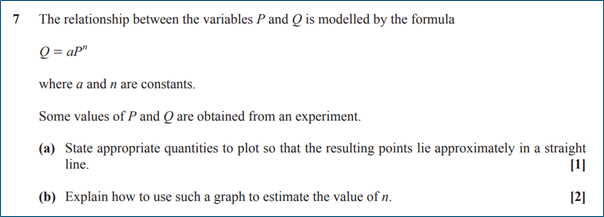
In order to reduce the algebraic relationship to a linear function, candidates must initially take logarithms on both sides for log Q = log aPn before separating out to give log Q = log a + n log P. Unfortunately, examiners often saw equations with ‘Q = …’ or terms such as ‘n log aP ’ or ‘n log a + P’.
Exam hints:
- Show each step of the manipulation as a separate line of mathematics: divide first, then log; or log first and separate with the correct laws as appropriate.
- Remember to state the base if not 10.
Extrapolation from data
Modelling is all about looking for relationships and patterns in data. However, students need to recognise the risks involved with extrapolating past data into the future. Questions that ask about the limitations of the model need to be considered within the context of the problem and focus on what assumptions may become invalid, or why the prediction becomes impossible after a certain time period.
Teaching suggestion:
- Review past paper modelling questions to discuss the assumptions made when defining the equations and suggest additional factors that will need to be considered over time.
Q9(a)(b) Maths B (MEI) H640/03 2023
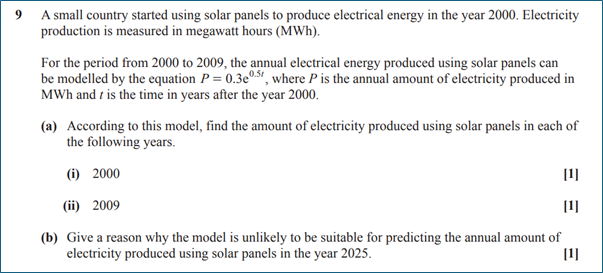
Part (a) looked at calculating numerical values within the 2000–2009 time period, so in part (b) it would make sense to calculate the value predicted by the model for 2025 and commenting on the unrealistic magnitude of increase (0.3 MWh in 2000 up to 80,501 MWh in 2025).
Exam hints:
- Any discussion about a mathematical model needs to be given in the context of the question.
- Write down a calculation if possible as part of the justification.
Numerical results
Questions often require candidates to complete a table and then plot the points to determine the coefficients for a straight line. The first cause of errors is premature rounding; if you want a final answer to two or three significant figures then the intermediate steps must always be completed with a greater degree of accuracy.
The main source of errors in these types of questions is forgetting to convert log values back into a normal number.
Another issue that students should be aware of is with the units used for the data. Time is generally measured from a stated zero reference point, and quantities may be quoted in thousands or hundredths depending upon the context.
Teaching suggestion
- encourage students to collect and graph real data from their other subjects to study logarithmic relationships in situations they are familiar with.
Q6 Maths B (MEI) H640/03 2020 (Graph given in the original exam paper)
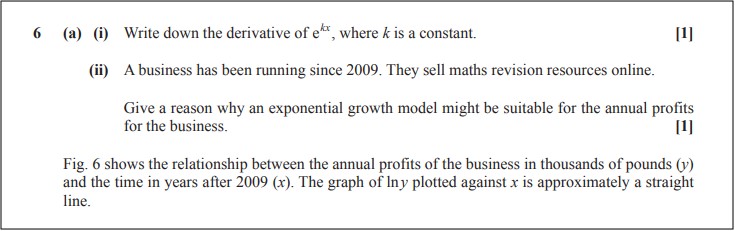
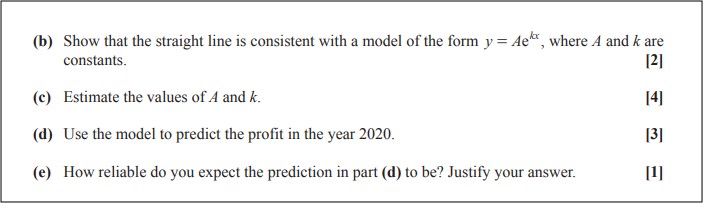
For part (b) on this paper, candidates were generally successful stating ln y = ln A + kx but didn’t make an explicit link to y = mx + c to show that a linear model was appropriate. The other major issue noted by assessors was in part (c) where candidates gave A = 1.9 rather than using the intercept to find ln A = 1.9. In part (d) some students did not spot that x = 11, whilst others correctly calculated y = 105 but did not then give profit as £105,000.
Note that in part (e) examiners would accept positive or negative responses to the validity of the model for 2020. While extrapolation two years beyond the collected data might feel reasonable, this cohort of students would be very aware of factors that would impact the sales of online maths revision guides.
Exam hints:
- Remember to explain how the calculation ‘shows that’ the given statement is true
- Always work at a greater degree of accuracy than required for the final answer
- Check units before stating final answer in context.
Final thoughts
Success with exponentials and logs is mostly about method discipline: apply the right log law, connect graphs to models explicitly, pay careful attention to units, and explain the limits of the model with a clear reason in the context of the set question.
Stay connected
Sign up for our A Level teacher networks each half term and our professional development webinars.
If you have any questions, you can email us at [email protected], call us on 01223 553998 or message us on social media.
Sign up for subject emails to receive the latest maths news, updates and resources.
If you are considering teaching any of our qualifications, use our online form to let us know, so that we can help you with more information.
About the author
Steven originally studied engineering before completing a PGCE in secondary mathematics. He has taught secondary maths in England and overseas. Steven joined Cambridge OCR in 2014 and worked on the redevelopment of the FSMQ and the A Level Mathematics suite of qualifications. Away from the office he enjoys cooking and to travel. You can follow Steven on BlueSky or Linkedin.
Related blogs