Cambridge Advanced Nationals in Applied Science: making science literacy make sense
18 August 2026
Amy Brewer, Science Subject Advisor

In readiness for the January 2027 series, I have put together some ideas and guidance to help teachers prepare their students for the Applied Science F181 Science in Society exam.
Those of you who have been teaching science for a number of years will have seen elements of our mandatory examined unit, Science in Society (F181), in previous qualifications. In creating the Cambridge Advanced National in Applied Science, teachers and universities told us that students still need a better grounding in the scientific method and a chance to engage with deeper critical thinking skills in preparation for their next journey onto a STEM degree.
But for teachers who haven’t experienced an examined unit with a pre-release, or who haven’t taught this kind of content before, I’ll share here a range of examples and ideas inspired by the questions we’ve received from teachers so far.
Where can I find resources for my lessons?
Cambridge OCR published materials
Teachers can find our detailed scheme of work and a few lesson resources on Teach Cambridge. The 80 guided learning hours (GLH) for this unit are fully accounted for, including time for revision and lessons to review the pre-release together. The lesson lengths vary because they are based on an area of study rather than the length of a single timetabled lesson, but they include a vast list of teaching ideas and links to external materials you might find useful.
For mock exams and practice, you can find the following on Teach Cambridge and ExamBuilder:
- the sample assessment material (SAM)
- a practice paper
- the January and June papers from last year
- our mapped questions from other qualifications to provide even more opportunities to assess F181 knowledge and skills.
The filters on ExamBuilder can help you select by the section of the paper, performance objective, question type, level of demand or command word to build a bespoke resource.
We have candidate style answers for F181 to help teachers and students understand how to write good answers. You could use these with the examiner reports to find out what the examiners were looking for and skills to practice.
I also recommend using our mathematics skills handbook, since a minimum of 25% of the overall marks available in the exams will be for the assessment of mathematical skills. And look out for candidate exemplars coming soon on Teach Cambridge.
Other supporting resources
I suggest:
Making lessons engaging and relevant
Example news stories
Relevant science news stories can really help students to engage with the specification content, as well as think critically about the benefits to society, and how they can exemplify the best (or worst) of scientific research.
Tips:
Here are a few of my favourites that could be used to illustrate and discuss topics from F181.
| Science in the news |
F181 Topic Area |
| This report from Scientific American summarises why an article in the British Medical Journal that appeared to implicate, erroneously, COVID vaccines with excess deaths post-pandemic was recently retracted. |
1.1 The skills of scientists (scepticism)
2.2 Collecting scientific data (meta-studies)
2.4 Interpreting data (draw conclusions)
3.3 Implications and limitations of scientific developments (public health)
4.1 Methods of communication (science magazines, process of peer review)
4.3 Using science to inform decision making
4.4 Problems with communicating science (misinformation, reporting bias)
|
| This news story from UK Health Security Agency could be used in contrast, with Gov.uk reporting a 50% drop in ICU admissions in the first full year of maternal RSV vaccines, despite only 60% uptake. |
3.3 Implications and limitations of scientific developments (public health)
4.1 Methods of communication (websites)
4.3 Using science to inform decision making (Government organisations)
4.4 Problems with communicating science (public trust)
|
| This Stanford Law and Biosciences blog about the use of a dead salmon that can apparently detect human emotions, and what it tells us about false positives. |
1.1 The skills of scientists (scepticism, objectivity, pragmatism)
1.2 The Scientific Method
1.4 The role of scientists
2.2 Collecting scientific data
4.1 Methods of communication (blogs, process of peer review)
4.4 Problems with communicating science (confirmation bias)
|
| The unfortunate use of a generative AI tool to translate information in a now retracted article from Materials Chemistry and Physics. For example, ‘phosphate buffer solution’ became ‘phosphate safeguard answer,’ ‘reaction mixture’ became ‘backlash combination,’ and the image in Figure 1 has a number of errors. |
1.1 The skills of scientists (communication)
4.1 Methods of communication (journals, peer review)
4.2 Plagiarism
4.4 Problems with communicating science.
|
This report from Scientific American summarises why an article in the British Medical Journal that appeared to implicate, erroneously, COVID vaccines with excess deaths post-pandemic was recently retracted.
Relevant to:
Topic 1.1 The skills of scientists (scepticism)
Topic 2.2 Collecting scientific data (meta-studies)
Topic 2.4 Interpreting data (draw conclusions)
Topic 3.3 Implications and limitations of scientific developments (public health)
Topic 4.1 Methods of communication (science magazines, process of peer review)
Topic 4.3 Using science to inform decision making
Topic 4.4 Problems with communicating science (misinformation, reporting bias)
This news story from UK Health Security Agency could be used in contrast, with Gov.uk reporting a 50% drop in ICU admissions in the first full year of maternal RSV vaccines, despite only 60% uptake.
Relevant to:
Topic 3.3 Implications and limitations of scientific developments (public health)
Topic 4.1 Methods of communication (websites)
Topic 4.3 Using science to inform decision making (Government organisations)
Topic 4.4 Problems with communicating science (public trust)
This Stanford Law and Biosciences blog about the use of a dead salmon that can apparently detect human emotions, and what it tells us about false positives.
Relevant to:
Topic 1.1 The skills of scientists (scepticism, objectivity, pragmatism)
Topic 1.2 The Scientific Method
Topic 1.4 The role of scientists
Topic 2.2 Collecting scientific data
Topic 4.1 Methods of communication (blogs, process of peer review
Topic 4.4 Problems with communicating science (confirmation bias)
The unfortunate use of a generative AI tool to translate information in a now retracted Materials Chemistry and Physics article. For example, ‘phosphate buffer solution’ became ‘phosphate safeguard answer,’ ‘reaction mixture’ became ‘backlash combination,’ and the image in Figure 1 has a number of errors.
Relevant to:
Topic 1.1 The skills of scientists (communication
Topic 4.1 Methods of communication (journals, peer review)
Topic 4.2 Plagiarism
Topic 4.4 Problems with communicating science.
Diversity and inclusion
One of the key things we ask our own authors to do when creating teaching resources is to think about accessible, modern and diverse representations of scientists and their work. Topic 1.3, The Scientific Community, is a great way of increasing representation and highlighting the value of diversity and inclusivity when it comes to innovations that should benefit everyone.
Example stories of failures include:
Meanwhile successful collaborations include
I’ve deliberately suggested a range of methods of communication in my examples as another aspect to review with students.
Finally, do make use of our STEM Contributor materials, whenever appropriate, to highlight diverse scientists and their work. There are hundreds of examples to choose from, and you can filter by GCSE or A Level topics that align with Applied Science.
Preparing for the exam
The pre-release
The addition of a pre-release for F181 is intended to help students feel more comfortable with some of the exam content and reduce some exam stress. In the first year of the qualification, examiners have already noted how well students seem to know and understand the pre-release material, which is really encouraging.
The pre-release is available on Teach Cambridge six teaching weeks before the exam, and our scheme of work recommends taking four hours of class time to engage and ask questions about the resource. Students may continue to prepare at home or in revision lessons.
Students can annotate the pre-release – they will be given a fresh one to use in the exam.
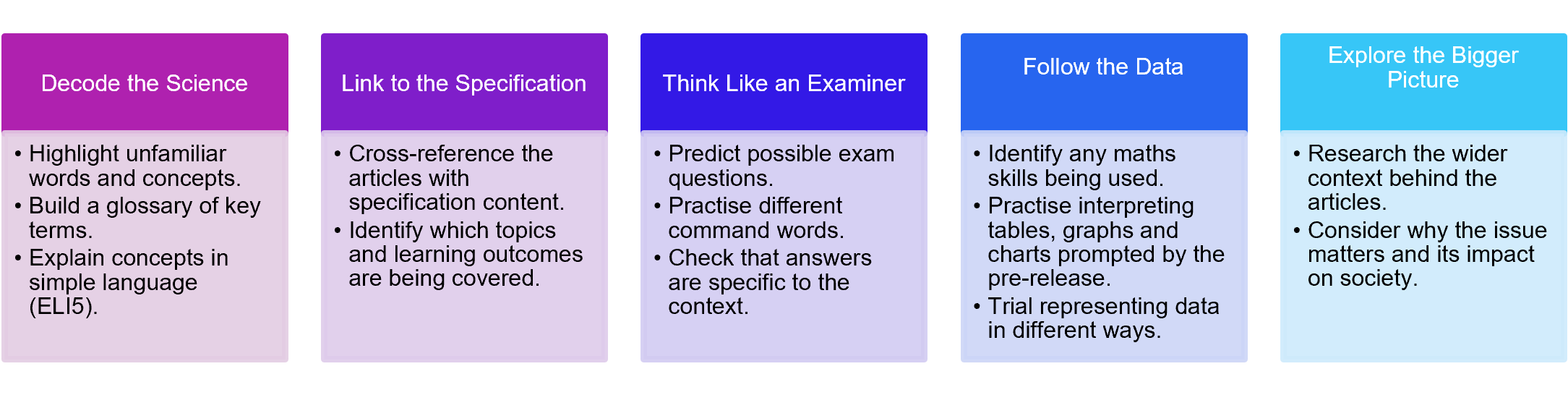
Example activities for the pre-release:
|
Decode the Science
|
- Highlight unfamiliar words and concepts.
- Build a glossary of key terms.
- Explain concepts in simple language (ELI5).
|
|
Link to the Specification
|
- Cross-reference the article with the specification content.
- Identify which topics and learning outcomes are being covered.
|
|
Think Like an Examiner
|
- Predict possible exam questions.
- Practise different command words.
- Check that answers are specific to the context.
|
|
Follow the Data
|
- Identify any maths skills being used.
- Practise interpreting tables, graphs and charts.
- Trial representing data in different ways.
|
|
Explore the Bigger Picture
|
- Research the wider context behind the article.
- Consider why the issue matters and its impact on society.
|
Key take-aways from the examiner reports
- A lack of knowledge of key definitions and use of specific terminology let responses down – build in retrieval practice with low-stakes quizzes…
- …but otherwise focus on scenario-based questioning.
- Responses must relate to the context – this is Applied Science after all.
- Avoid repeating info from the pre-release or the question. This won’t earn marks and can waste precious time.
- Read the question carefully and respond to the command word used.
- Level of Response: analyse, provide conclusions with justification, address both sides and any bullet points given. Responses can be in bullet points or comparative tables!
- Practice those maths skills, and don’t assume calculator competency or skills from GCSE – put the maths skill in a science context too.
Stay connected
Check out our latest professional development offer here, with Exam Reviews, Enhancing your Teaching and Ask the Subject Advisor events to support you.
If you have any questions, you can email us at science@ocr.org.uk or call us on 01223 553998. You can also sign up to subject emails for the latest news, updates and resources.
If you are considering teaching any of our qualifications, use our online form to let us know, so that we can help you with more information.
About the author
Amy joined Cambridge OCR in May 2022 and is a subject advisor for GCSE Sciences and Applied Science. Before that, Amy taught Chemistry to 11-18 year olds for 16 years and was responsible for planning her school’s science schemes of learning. In addition to her teaching responsibilities, Amy mentored trainee teachers, was responsible for the progress of KS5 science students. She is committed to improving diversity and inclusion in the sciences.
Related blogs