Making core maths assessments straightforward
03 March 2026
Ruth Wroe, Maths Subject Advisor

We’ve been consulting teachers on how to improve the accessibility of our core maths exam papers. In this post I’ll look at some of the improvements you can expect to see in the papers for the 2026 exam series and beyond, and how these changes are designed to help students.
Our key changes include:
- using Arial font to improve readability
- answer spaces are dotted lines positioned after each question part
- questions and formatting are in line with our current accessibility principles.
Making assessment straightforward
We’re committed to making assessment straightforward, so every student can thrive and achieve the results they deserve. You can find more details on how we are focusing on accessibility, fairness, and consistency across all our qualifications on our Introducing Cambridge OCR web page.
You can also read our blog about the importance of accessibility.
Formatting
We’ve changed the text font from Times New Roman to Arial to improve readability. Arial is a sans-serif font which most people find easier and quicker to read. Almost all Cambridge OCR papers already use Arial font, including GCSE Maths and Level 3 FSMQ Additional Maths, so it will be familiar to core maths students. Where Arial font does not work well for particular maths symbols, such as pi, we’ll use a different font.
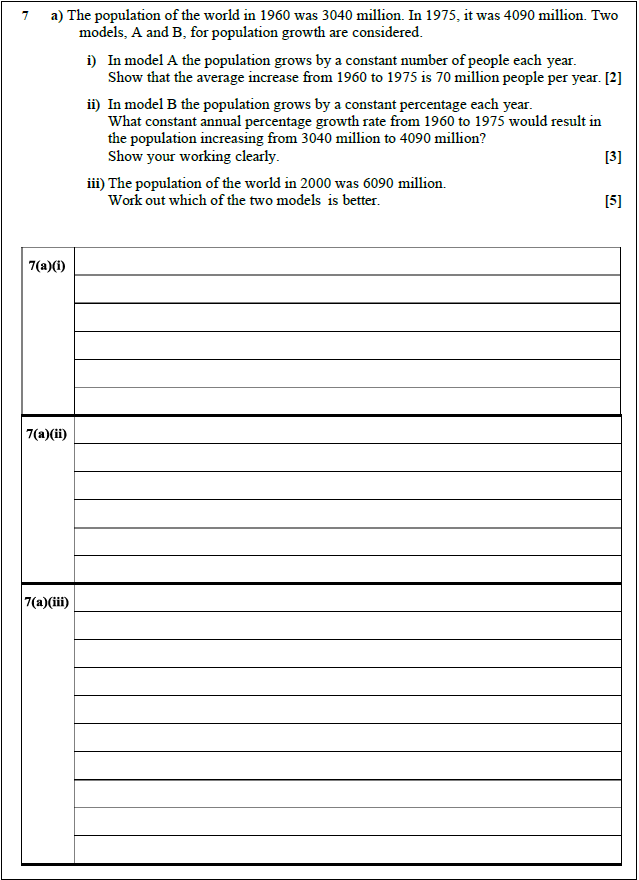
We’ve changed the format of the answer spaces to make it clearer to students where to write responses. We have used friendlier dotted answer lines, and they are after each question part.
Before:
After:
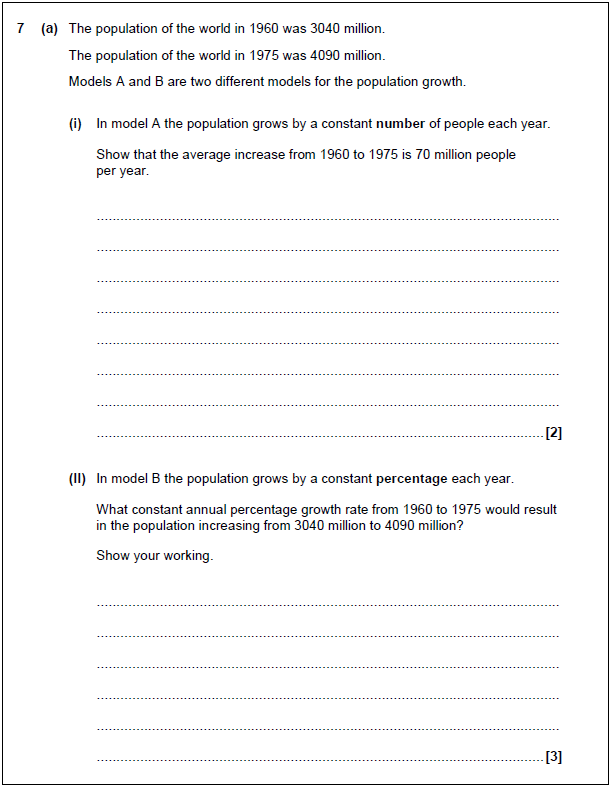
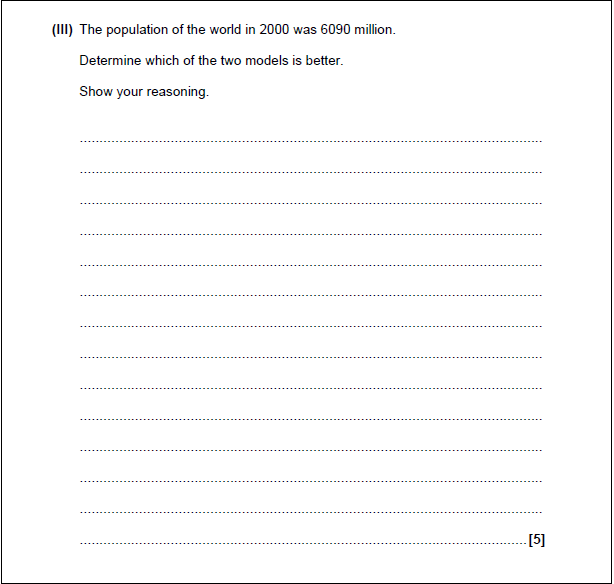
Before making these changes, we shared the new design with teachers to gather feedback. They were overwhelmingly in favour of the new design, highlighting these positive features:
- They look more like GCSE papers that students are familiar with.
- The use of dotted lines looks less threatening for students, and they are used to this format at GCSE.
- Positioning the answer space underneath each question part makes it less likely for students to miss out parts of questions, or leave answers blank, by mistake.
- Linking the answer space directly to a specific question part also makes it more difficult for students to accidently put the answer in the wrong place.
- The new look and format is much friendlier and easier to process for the less able students, which should make for a fairer assessment.
Formatting features that we’ve already introduced to our core maths papers, as part of our continuous improvements, include:
- starting each new instruction on a new line to ensure all the information is processed
- using bold for key words so students can see the important parts of a question
- using figure references for graphs and tables only where essential, to reduce the amount of information to process.
Language
Our question papers are designed to be clear and straightforward. We use Plain English principles to make sure students understand what is being asked.
The question styles used in our core maths papers are written with the latest Cambridge OCR and Ofqual accessibility guidance in mind. They follow the established norms for assessment of core maths and allow for consistent marking and fairness for all students.
Questions that have several separate instructions are presented as several question parts. This avoids students holding large amounts of information in their working memory, which is not the required skill being assessed.
For questions where a student needs to successfully complete a short initial procedure to then solve a multi-step problem, the initial step is a clearly separate question part. This gives students the opportunity to show what they can do and get credit for it. We aim to give some credit to students who have used and communicated a reasonable approach to problem solving, even if it is incomplete or they make an error. Separating the procedural and problem-solving elements of the question allows follow-through marks to be awarded more accurately, allowing for a fairer assessment.
We’ve also already introduced the following language improvements to our core maths papers:
- using language that students are familiar with
- using pre-release materials to provide definitions of unfamiliar language before the exam
- only using technical words that appear in the specification, which students are required to know
- using short and simple sentences to avoid unnecessary words
- using terminology consistently.
These changes reduce the cognitive load of reading, meaning students can focus on the maths being assessed.
Context
We use pre-release materials in core maths to familiarise students with contexts in advance of the exam, so that they can focus on problem solving during the exam.
Pre-release materials will be released on or after 1 March, in line with other core maths qualifications. This allows more lesson time than previous years for teachers and students to work with the pre-release material before the summer exam.
You can download pre-release materials from the ‘Assessment’ Teach Cambridge pages for Core Maths A and Core Maths B.
Additional context features that we’ve already introduced to our core maths papers, as part of our continuous improvements, include:
- using contexts that students are likely to be familiar with, so they are not distracted from the question being asked
- avoiding context that is irrelevant to the question, to reduce the reading load
- avoiding names of people or organisations, where possible
- only using names from a set list of equality, diversity and inclusion-approved accessibly written names.
Support
We’ve updated the sample assessment materials (SAMs) and candidate style answers in line with our new question paper style so that teachers and students can become familiar with the formatting changes ahead of the 2026 exams.
To further help in exam preparation, we’ve also amended some of our recent past papers to the new style. Reformatted versions of our June 2025 question papers are already available and June 2024 question papers will follow shortly.
You can download these updated materials from the ‘Assessment’ Teach Cambridge pages for Core Maths A and Core Maths B.
Stay connected
Share your thoughts in the comments below. If you have any questions, you can email us at [email protected] or call us on 01223 553998. You can also sign up for subject updates and receive information about resources and support.
If you are considering teaching any of our qualifications, use our online form to let us know, so that we can help you with more information.
About the author
Ruth supports the Level 3 maths qualifications and has chief responsibility for Core Maths A and B. She joined the maths team in 2014, working on the development of A Level Maths. Previously, Ruth taught maths in the UK, New Zealand, Kuwait, Oman and Qatar. Outside of work she enjoys travelling, live music and real ale.
Related blogs