Using Geographical Information Systems in the classroom
12 May 2026
Kiaran Ratcliffe and Samantha Yates, GIS Education Consultants at Esri UK


This article is a guest post. The views and opinions expressed are those of the authors and do not necessarily reflect those of Cambridge OCR. Reference to specific products, services or platforms does not imply endorsement.
At Cambridge OCR, we aim to share practical insights that help teachers bring complex ideas to life in the classroom. GIS (Geographical Information Systems) is an area that continues to grow in importance across many subjects in the curriculum.
To support teachers exploring this area, we invited colleagues from Esri UK to outline what GIS is, how spatial analysis works, and how these tools can contribute to teaching and learning within our GCSE and A Level qualifications.
What is spatial analysis and GIS?
Spatial analysis and GIS tools are part of many aspects of modern life. They help people understand where things happen and why, from global supply chains, to fixing pot-holes and broken pipes, and responding to natural hazards such as earthquakes, fires and hurricanes.
In this blog we’ll explain how the technology links to the Cambridge OCR curriculum, and outline resources available to support you and your students.
Spatial analysis is the act of taking raw data and turning it into actionable insight - information you can use to make a decision or understand a problem.
Various kinds of analysis can transform raw data into usable information, including statistical analysis in maths or science, or narrative analysis in English. For analysis to be spatial, the data needs to be geographic. That means there is something about it that relates to location: where something has or will or could happen. Location data can be very precise, like a grid reference, or it can be quite broad like the name of a country. As long as there’s something in the data that refers to location, the data is geographic.
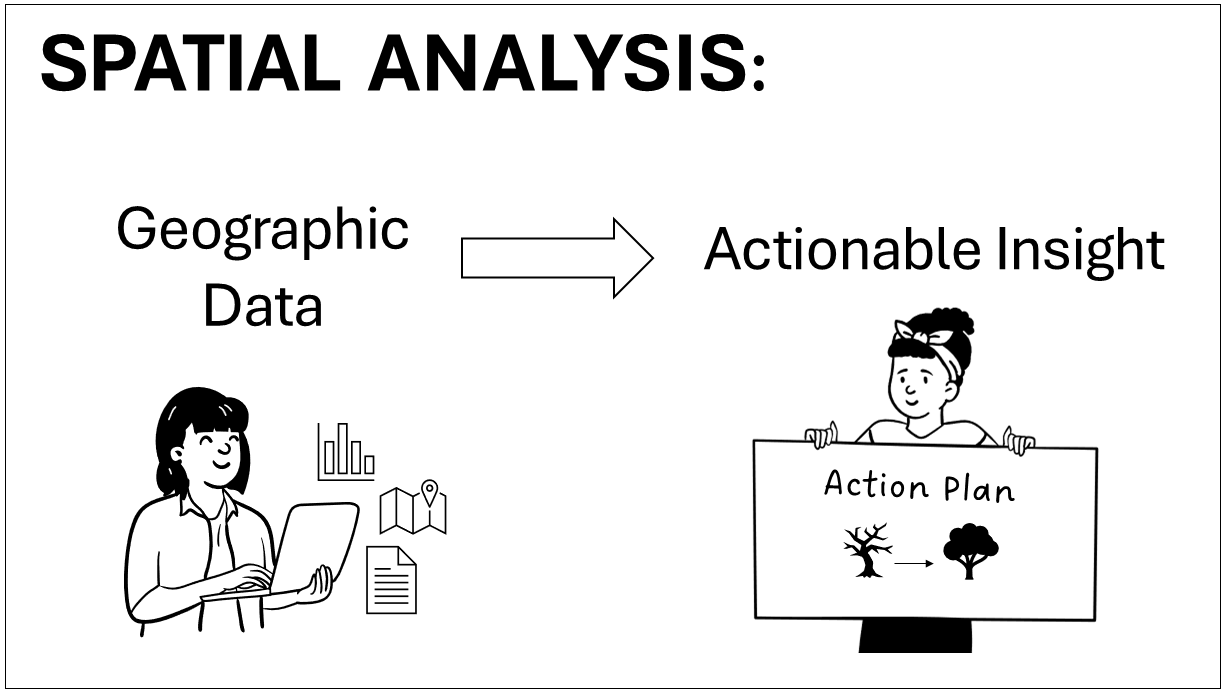
GIS is the technology that integrates geographic data (where things are) with all types of descriptive information (what things are like there). It combines maps with descriptive data so that users can explore questions, test ideas, and communicate findings clearly.
For example, conservationists could track animals using location data. The data is geographic because it contains locations: in this case the origin country of the animal, and the latitude and longitude of its last known position. A number of these animals seem to have died recently. From a spreadsheet alone it’s difficult to see any patterns or relationships that might explain why. As the data is geographic, using GIS to create a map could reveal patterns through spatial analysis.
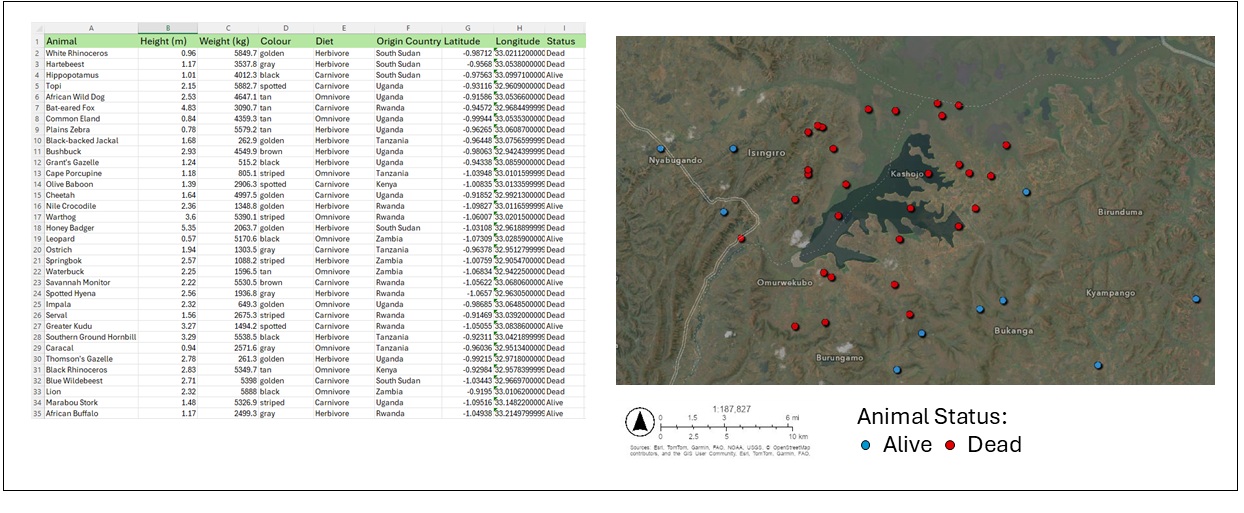
Seeing the animals represented like this on a map suggests that the water source of Lake Nakivali was related to their cause of death and needs investigating urgently.
How can GIS support Cambridge OCR GCSE and A Level qualifications?
GIS can be used to support student learning across a range of subjects:
History
- Digital maps and globes can be used to locate and visualise places, for comparison with historic maps and 3D models comparing different time periods.
- Historic data such as transport routes of the Roman Empire or letters from Victorian poor people trying to obtain relief can support learning.
Science
- GIS is widely used in environmental science to map ecosystems and species, understand changes in weather and climate, and monitor pollution.
- Tracking and monitoring outbreaks of disease and making decisions about the location of health services are important uses of GIS in the health sciences.
Maths and Computing
- GIS tools can be used to model networks such as road systems and utilities, providing case studies of shortest path algorithms, optimisation, and nodes and edges in graph theory.
- Students can work with large datasets in GIS, integrating multiple types of data. This can support a range of mathematical modelling (e.g. exponential decay to model pollution spread, flood risk using contour functions, and predicting population growth through logistic growth function).
Geography
Resources that may support teaching and learning
Teach with GIS
Teach with GIS includes a collection of classroom-ready resources and examples suitable for different subjects and key stages. These include interactive maps, lesson ideas, careers information and an archive of recorded training events. The materials can be accessed without login and are freely available.
ArcGIS for Schools
ArcGIS for Schools is a completely free, industry-standard GIS software for schools that wish to explore mapping and spatial analysis in more depth. Teachers and students can have their own accounts that allow them to create maps, apps, collect fieldwork data and run their own spatial analyses.
Professional development
Esri UK and the Royal Geographical Society provide training opportunities for teachers at different levels of experience, including gaining Chartered Geographer Teacher status. These include online and face-to-face sessions focusing on classroom practice and the use of GIS in the curriculum. Please get in touch if you’d like to arrange professional development.
Teachers who have used these tools report that GIS can help students:
- Visualise complex ideas
- Strengthen their understanding of place
- Develop skills in spatial literacy and analysis
Stay connected
If you have any questions about Cambridge OCR qualifications, you can email us [email protected] or call us on 01223 553998. You can also sign up for email updates for information about resources and support.
About the authors
Sam and Kiaran are both GIS Consultants at Esri UK, supporting the education community to unlock the power of geospatial data and technology.
Sam has been part of the geospatial industry for the last 5 years, previously working with NIRAS International Consulting, enabling the spatial and environmental planning of low carbon infrastructure and energy systems across Europe, East Africa and South-East Asia. She now works with both educators and students to implement more GIS in teaching by delivering PGCE and CPD training and by creating a wide range of teaching resources, all available on the Teach With GIS website.
Kiaran joined Esri UK in January 2025. Before that, he worked as an Associate Lecturer in GIS at Sheffield Hallam University for four years, supporting teaching and learning across a range of geospatial topics. In his current role he works across all stages of education, from primary through to higher education, delivering training and support to embed GIS into teaching and learning, as well as contributing to research initiatives that apply geospatial approaches to real-world challenges.