What does the Curriculum and Assessment Review mean for GCSE and A Level Geography?
13 January 2026
Kerry Sage and Shelley Monk, Geography Subject Advisors


The government’s Curriculum and Assessment Review (CAR) was published in November, alongside the Department for Education’s (DfE) response to the review.
In this blog we highlight the key recommendations relating to GCSE and A Level Geography and what they mean for classroom teachers.
Geography at GCSE
The most prominent headline for GCSE Geography is that “some GCSE subject content in Geography is overly dense and repetitive, with some that is duplicated and outdated. There is repetition in certain topics (for example hazards, ecosystems and development), limiting opportunities for deeper understanding of key geographical concepts, processes and interconnections.”
The government’s response says, “We agree with the Review that the subject does not need significant change, and we will update and refine the programme of study and GCSE subject content with modest changes, to support pupils and teachers.”
Teachers and stakeholders have already shared their thoughts with us on the recommendations, which has been extremely valuable, as we continue to review and refine our qualifications.
We would love to hear your thoughts. Let us know if you would like to be part of our new shaping future geography group. The remit of this group is to work with Cambridge OCR to help make decisions and shape the future of geography qualifications.
We look forward to discussions with the DfE about the “light touch” changes to the subject criteria. The recommended changes from the DfE will be used alongside teacher and stakeholder feedback, to shape our qualifications moving forward.
Assessment at GCSE and what it means for schools
The government committed to “reduce examination time by on average 2.5-3 hours overall for the average student taking eight or nine GCSEs.” This commitment is likely to result in some assessment changes at GCSE. We will keep you updated as to what this will look like.
We have been reviewing the assessment approach for our qualifications as at Cambridge OCR we are committed to making sure our assessments are straightforward for all students.
Fieldwork in geography
The CAR “aims to clarify and strengthen how fieldwork is embedded within the curriculum, showing how it connects to other geographical skills and knowledge.” The government response agrees that changes are needed to “clarify and integrate the fieldwork requirements.”
We believe that fieldwork is an integral part of studying geography, as it enables students to see the concepts and content learnt in the classroom in a real-world environment. Complex and subject-specific language can be demystified and bought to life ‘in the field’. Through fieldwork opportunities in the curriculum, students can develop a wide range of skills relevant to their further study or employment opportunities. We want to ensure fieldwork skills continue to be relevant to young people and their futures and we would welcome a review of these.
We have heard from our teachers and stakeholders about the challenges and barriers to conducting and completing successful fieldwork. We are committed to making sure the requirements around fieldwork are clear and accessible and its value to the subject discipline is evident.
We continue to explore the assessment of fieldwork and look forward to further discussion about this, particularly in relation to the students’ own fieldwork and particular skills identified for assessment.
Climate education and sustainability
The report states that the “current Geography curriculum has notable gaps in relation to climate change. Responses to the Call for Evidence highlighted strong support from subject experts and young people for greater attention to this in the Geography curriculum. The climate crisis is the most significant environmental challenge of modern times and, given that climate and weather are anchored in the existing Geography curriculum, it is essential that the Geography curriculum embeds climate education and sustainability appropriately across the key stages. In addition to the presently scant mention in the curriculum, the present overall purpose of study in the national curriculum does not explicitly identify climate change as a key concept.”
“The purpose of study in the national curriculum should be amended to ensure explicit wording, empowering the next generation of geographers to understand and tackle climate change through suitable climate education.”
The CAR makes recommendations “to bolster the presence of climate education and sustainability in the Science and Geography curricula.”
The government has said that they will “take the opportunity to enhance the climate education content which is already present in the national curriculum, in the subjects of geography, science and citizenship”.
We are delighted that the CAR report and government response aligns with our focus and approach at Cambridge University Press and Assessment. We believe that climate education equips young people with the knowledge and skills to understand the complexities of climate change and encourages them to become active participants in tackling this global challenge. Find out more about our approach to climate education.
The big question: when will GCSE and A Level geography be reformed?
The government response to the review outlined a timeline for the proposed qualification reforms. The report (p.52) indicates that GCSEs will be reformed in two phases, with the Phase 1 GCSEs scheduled for first teach in September 2029 and Phase 2 scheduled for first teach in September 2030. We are waiting to hear which phase geography will be placed in.
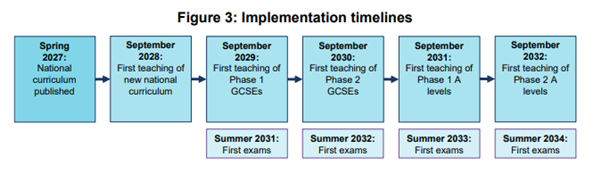
According to the government response, there are no plans to make “substantial” changes to A Levels at the current time. However, they note that reform will be considered “in subjects where the Review has suggested GCSE-level change.” It might, therefore, be expected that A Level Geography will be reformed to ensure it is consistent with changes at GCSE. As with GCSEs, A Level qualifications will be reformed in two phases, with first teaching taking place in September 2031 and 2032.
What happens now?
Curriculum reform is a huge undertaking and the CAR is just the beginning. We should probably keep in mind that the content of the report will not necessarily be adopted as government policy. There is a long way to go yet, with a proposed reform ‘moment’ of September 2029, meaning first assessment of new GCSEs in 2031 and A Levels in 2033. Further consultations between awarding bodies and the DfE are ongoing, and our aim is to actively best represent your views and opinions in those consultations.
Join our CAR briefing webinar
We’ll be running a free CAR briefing webinar on 2 February 2026 to explain the impact of the Curriculum and Assessment Review on geography. You’ll have a chance to ask questions and pass on your thoughts about the proposed changes. You can join any of our briefings by signing up on the teacher network and subject briefings page.
Stay connected
At Cambridge OCR we’re committed to making assessment straightforward and are here to support teachers and students at every step of the way. Contact us if you have any specific questions about the CAR, or what it means for you and your students.
You can always join our teacher panels to help us shape the development of these qualifications as we go through reform.
To stay up to date with subject news from us, make sure you sign up to receive our email updates. You can also email us at geography@ocr.org.uk.
About the author
Kerry joined the Subject Advisor team in April 2023 after 18 years of teaching geography along with other subjects such as Environmental Science. As well as being Head of Geography she had other roles such as associate SLT and Deputy Designated Safeguarding Lead. She loves to travel and trained as an Icelandic Teacher Tour Guide.
Shelley joined OCR after teaching geography for 16 years. She has considerable experience in delivering GCSE, IGCSE, A Level and the International Baccalaureate qualifications, as well as leading departments in secondary schools in the UK and internationally. She has eight years’ experience as Head of Year 12 and 13, supporting students both pastorally and academically. Shelley worked with the geography team to reform the GCSE, AS and A Level qualifications and she currently supports teachers through the development of a variety of resources, the CPD programme and subject communications. She loves walking her dog, exploring distant places and finding new recipes to trial on family and friends.