What goes into creating a Cambridge OCR question paper?
05 June 2026
Joanne Malpass, Assessment Standards Manager
 Each year, hundreds of question papers and other assessment materials (which can include inserts, resource booklets, formulae sheets, pre-release materials, answer booklets and other items) arrive in schools ready for students to sit their exams.
In this blog I’ll describe the whole assessment material production process and the roles involved.
The question paper timeline
To make sure question papers are produced on time and fit for purpose, many people and processes are involved.
The process starts around 18 months to 2 years before the paper is due to be sat.
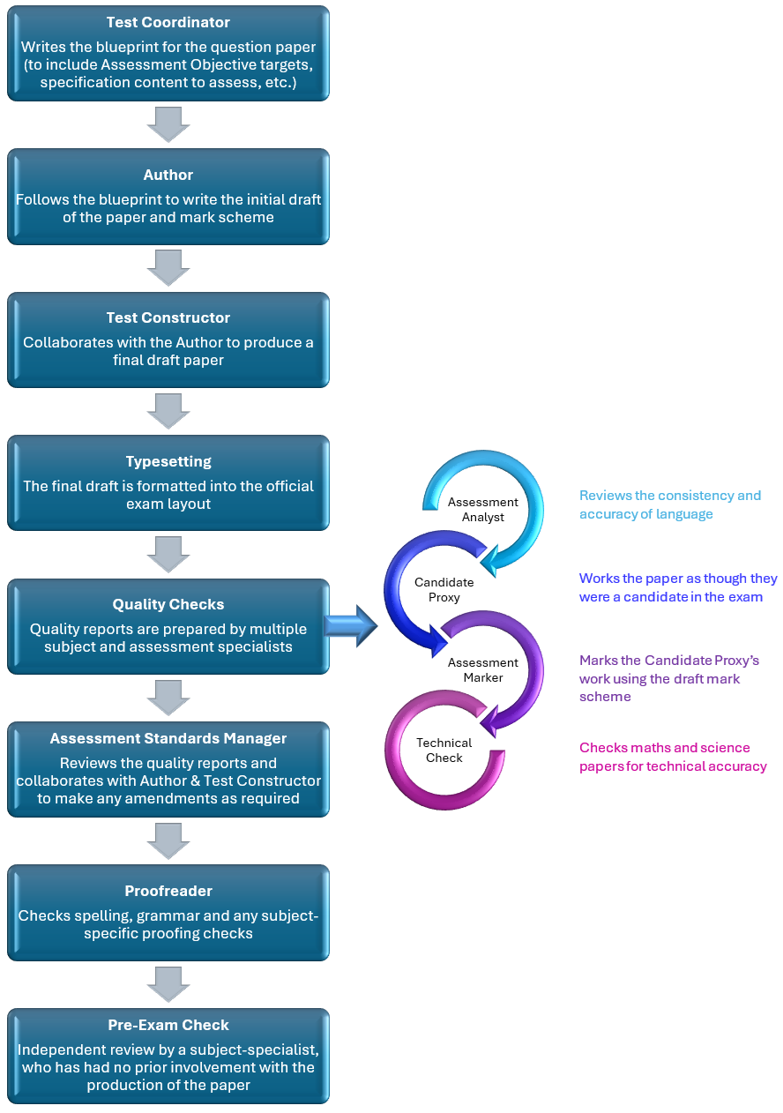
- Firstly, a test coordinator creates a blueprint for the question paper, including the assessment objective targets and specification content to assess.
- The question paper author uses the blueprint to write the initial draft of the paper and create a draft mark scheme.
- The test constructor works with the author to finalise the draft paper.
- The draft paper is then typeset and formatted into the official exam layout.
- Various subject specialists and assessment specialists review the paper and produce quality reports.
- An assessment analyst reviews the consistency and accuracy of language.
- A candidate proxy attempts the paper as if they were a candidate.
- An assessment marker marks the candidate proxy’s work using the draft mark scheme.
- Maths and science papers are checked by subject specialists for technical accuracy.
- The assessment standards manager reviews the quality reports and works with the author and test constructor to makes amendments where needed.
- A proofreader checks spelling, grammar and any specific subject checks.
- After proofreading, many qualifications have an independent subject specialist conduct a pre-exam check.
The process generally ends 6-12 months before the paper is due to be sat, when the final version of materials to be received on candidate desks is signed off or ‘passed for print’. For example, a question paper taken in May 2026 is likely to have been passed for print around August to December 2025.
The following diagram shows the whole assessment material production process and the roles involved.
Mark schemes
Mark schemes follow a slightly different timeline. The author will produce a draft mark scheme at the same time the question paper is written, which will be updated to reflect any updates made during question paper drafting.
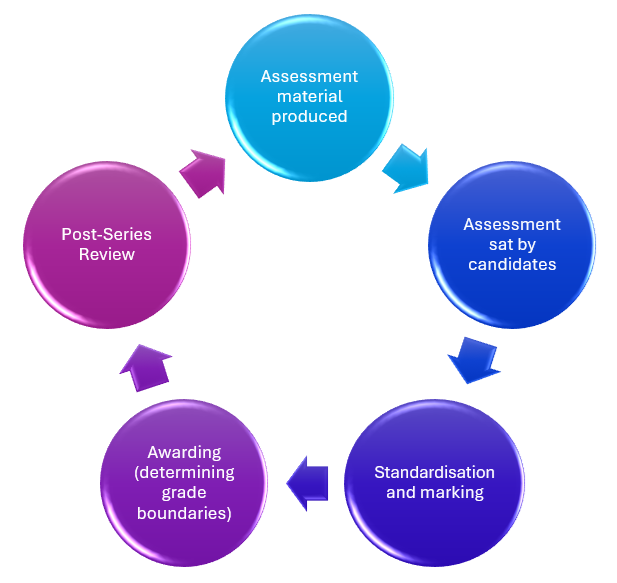
However, the final mark scheme will only be produced in the standardisation period (after candidates have sat the exam, but before exam marking begins). During this time senior examiners will review a sample of candidate responses from the exam, to make sure that the mark scheme is fit for purpose. They will then share the final mark scheme with all examiners, ready for the marking period to begin.
Grade boundaries
Grade boundaries are determined after the marking period, in a process known as awarding. For an exam sat in June, this is likely to be in late July. To ensure assessment standards are maintained year on year, a range of factors are considered including candidate performance, the difficulty of the exam relative to previous years, the ability of the cohort and others. These will all feed into the awarding process to determine grade boundaries.
Reviewing
After the exam series, a meeting is held for each qualification to review and discuss student performance, question paper performance and any challenges that arose during the series.
This will include comments and feedback from centres, data on candidate performance (on individual questions, individual components and the whole qualification) and any other relevant information. For an exam sat in June, the review will be held during the autumn.
The post-series review completes the assessment cycle. Outcomes from the post-series review are used to improve future assessment materials.
Stay connected
If you have any questions, you can email us at support@ocr.org.uk or call us on 01223 553998. You can also sign up for subject emails for the latest news, updates and resources for your subject areas.
And if you are considering teaching any of our qualifications, use our online form to let us know, so that we can help you with more information.
About the author
Joanne was an A Level Psychology teacher for 17 years in Further Education colleges in the north of England and marked as an Assistant Examiner on various Cambridge OCR and Cambridge International qualifications for over 12 years. She left the classroom to bring her experience in education and assessment to Cambridge OCR in May 2023.