A Level Maths: tips for happier circle experience
06 May 2026
Steven Walker, Maths Subject Advisor

In focusing on the more advanced calculus and statistical tests, students often do not spend sufficient time on practicing their fundamental algebraic skills in the run up to their A Level exams. Examiners frequently highlight issues with algebraic manipulation, applications of assumed GCSE knowledge, and poorly structured solutions to multi-step problems on coordinate geometry and equation of circles questions.
This blog summarises common examiner observations on equations of circles and highlights key areas where students lose marks, with short teaching suggestions for classroom emphasis.
Practice algebraic manipulation
Examiners report errors with incorrect signs and mistakes rearranging terms across the equals sign, especially when applying the completing the square process for changing between x2 + y2 + px + qy + r = 0 and (x – a)2 + (y – b)2 = R2 formats.
Exam hint: A quick check is to make sure that your centre (a , b) comes from halving the linear coefficients p and q.
Q4 H240/03 2023
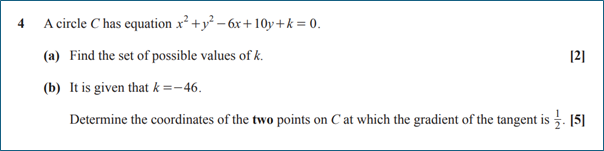
In part (a) students need to demonstrate their ability to apply completing the square before going on to find the minimum k value for generating a circle. Common mistakes seen were using ±6 and ±10 inside the brackets or using ±36 and ±100 outside the brackets.
Teaching idea: Use graphing software to generate different circles and check students can find the equation in the alternate format. Challenge students to create equations that use common variables in both formats.
Revision of circle theorems
The tangent to a circle is perpendicular to the radius and the angle in a semi-circle is 90 degrees are assumed prior knowledge from GCSE (9–1) Mathematics.
Exam hint: Sketch the equations to help identify perpendicular lines.
Q8 AS H230/01 2023
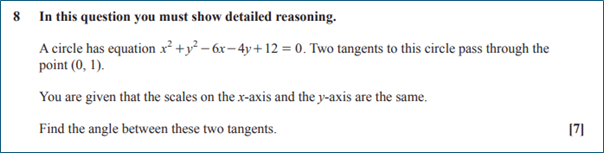
Most candidates found the centre of the circle by completing the square but then attempted to form equations for the tangents (issues highlighted in this Desmos graph). An annotated sketch reveals the fact that one tangent is a horizontal line, so the problem is reduced to finding and doubling the angle in a right-angled triangle using trigonometry.
Teaching idea: Link the equation of a circle to Pythagoras triples since this allows practice with circumference coordinates with some integer values without the added complexity of handling surds.
Investigate synoptic links across the content
Questions may link circles with tangents or normals of straight-line graphs, areas enclosed between curves and lines, or parametric equations.
Exam hint: read the full question before attempting any individual parts. Draw an annotated sketch and sense check the shape using the information in the question.
Q6 H640/02 2023
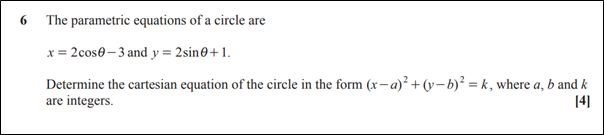
In this question, students need to demonstrate their understanding of the Pythagorean identity sin2θ + cos2θ = 1 to produce a clear mathematical justification of their answer. Many students correctly identified the centre and radius but did not justify their answer for full credit.
Teaching idea: Use ExamBuilder to select and edit past paper questions for your students to practice.
Support
You will find delivery guides, check in tests, and progress tests on Teach Cambridge, along with past papers, mark schemes and examiner reports.
Other resources you may find useful:
You may find this collection of Desmos graphs a useful starting point for investigating circle problems and an article on equations of circles would not be complete without mentioning the Teddy bear activity on Underground Mathematics.
Stay connected
Sign up for our A Level teacher networks each half term and our professional development webinars.
If you have any questions, you can email us at [email protected], call us on 01223 553998 or message us on social media. Sign up for subject emails for the latest maths news, updates and resources.
If you are considering teaching any of our qualifications, use our online form to let us know, so that we can help you with more information.
About the author
Steven originally studied engineering before completing a PGCE in secondary mathematics. He has taught secondary maths in England and overseas. Steven joined Cambridge OCR in 2014 and worked on the redevelopment of the FSMQ and the A Level Mathematics suite of qualifications. Away from the office he enjoys cooking and to travel. You can follow Steven on BlueSky or Linkedin.
By the same author