FSMQ: a student guide to command words
01 October 2026
Steven Walker, Maths Subject Advisor

In this blog I’ll explore the command words used in the Free Standing Maths Qualification (FSMQ) and share practical strategies to help students structure their solutions.
The FSMQ develops students’ mathematical communication and problem-solving skills through questions that are often set in modelling contexts. Although full written solutions are rewarded, question wording guides students on the level of working expected by examiners. FSMQ command words are consistent with those used in Cambridge OCR AS and A Level Mathematics and Further Mathematics.
We have a useful student poster summarising command words.
Give, state, write down
These command words indicate that little or no calculation is needed, with answers usually taken from given information or previous work.
Q9 FSMQ 6993 Summer 2024
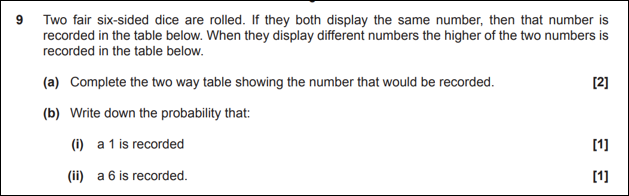
In part (b), students used their table from part (a) to write down the required probabilities.
Teaching idea: To reinforce understanding, ask students to verbally ‘state’ or use mini whiteboards to ‘write down’ key features or terms during whole-class review.
Show that and determine
‘Show that’ and ‘determine’ require a clear mathematical argument to justify the answer. Encourage students to present consistent working and explain the purpose and accuracy of each step.
Q12 FSMQ Summer 2025
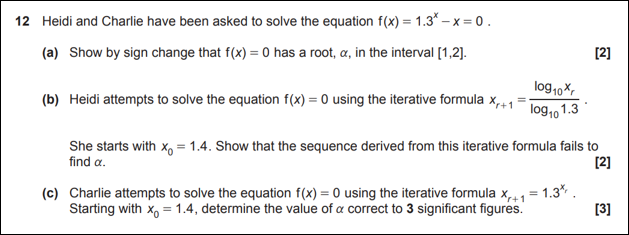
In part (a) it is not sufficient to solely calculate f(1) and f(2), it is also necessary to state that since f(2) < 0 < f(1) there is a sign change which shows that 1 < α < 2. Part (b) requires students to calculate the iteration values and explain why the method is unsuccessful. In part (c), ‘determine’ indicates that enough terms must be calculated to justify rounding to 3 significant figures.
Teaching idea: Ask students to ‘find’ or ‘calculate’ an answer and then challenge the whole class to then ‘show that’ the given result is correct.
In this question you must show detailed reasoning (DR)
This command phrase indicates that a complete algebraic method must be shown, with mathematically correct working throughout. Errors with brackets, powers and equals signs are often penalised in DR questions. This is not a ‘do not use a calculator’ instruction, but students must demonstrate the mathematics behind any calculator-generated results.
For example, a student may solve a quadratic equation using the solve function but would need to either quote the factors as bracketed terms, as a completed square expression or as the substitution into the formula.
Q15 FSMQ Summer 2023
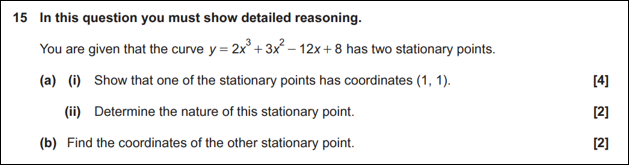
This question could be answered using a graphical display calculator or a scientific calculator's table function, but neither demonstrates the calculus and algebraic techniques required by the specification (good practice to check working, Desmos example).
The DR statement means that in part (a)(i) the examiner is looking for an expression for dy/dx, solved for when dy/dx = 0, confirming that x =1 is a solution and finding the value of y for this x value. In part (a)(ii) students need to show either the second differential, or use change of sign, to determine if (1,1) is a maximum or minimum. Part (b) the second x value found in part (a)(i) is used to find the second pair of coordinates.
Teaching idea: Graphing software rejects algebraic errors, making it an effective way to promote accurate notation without extensive marking. Encourage students to create the graphs presented in textbook and exam questions using software, with the added challenge to make the graph interactive with sliders.
Calculate, solve, find
These questions do not specifically require written working, and a correct calculator-generated answer can earn full marks. However, showing working is good practice and may gain method marks even if the final result is incorrect.
Q1 FSMQ Summer 2025

While a student that just writes ‘−1080’ would gain all 3 marks, forgetting the negative sign, to cube the 3, square the 2 or multiply by 10 with no working would score zero. Showing working helps ensure each step is completed correctly and may secure partial credit if mistakes occur.
Teaching idea: encourage students to show their working for all calculations.
Stay connected
Sign up for our A Level teacher networks each half term and our professional development webinars.
If you have any questions, you can email us at [email protected], call us on 01223 553998 or message us on social media. Sign up for subject emails for the latest maths news, updates and resources.
If you are considering teaching any of our qualifications, use our online form to let us know, so that we can help you with more information.
About the author
Steven originally studied engineering before completing a PGCE in secondary mathematics. He has taught secondary maths in England and overseas. Steven joined Cambridge OCR in 2014 and worked on the redevelopment of the FSMQ and the A Level Mathematics suite of qualifications. Away from the office he enjoys cooking and to travel. You can follow Steven on BlueSky or Linkedin.
Related blogs