A Level Maths: using legacy questions
13 April 2026
This blog has been updated from the version originally published in 2020.
Steven Walker, Maths Subject Advisor

Teachers naturally look towards their exam board for quality assessment questions to use with their students. In this blog I’ll revisit the changes from the legacy assessment criteria compared to the requirements in the reformed qualification, and source legacy questions that you could adapt for use with your current students.
Moving from modular
One of the drawbacks of the old modular structure was that each paper focused on a small section of the full specification, and there was a view that this was a barrier to students gaining an appreciation of the links between topics in mathematics. While this does mean that legacy questions may not include the breadth of synopticity that might appear in the current exams, there is still value in using the questions from the legacy qualifications for revision purposes.
Synoptic questions in A Level Maths
One of the concerns highlighted with the unitised approach to A Levels was that students were studying chunks of content in silo and not seeing the whole intertwined beauty of the subject. The legacy A Level Maths overcame this to some degree with the caveat that the content of the previous units was assumed knowledge, and even within a unit there were always opportunities to make links between topics. Many questions from the legacy specification will still meet the synoptic requirements.
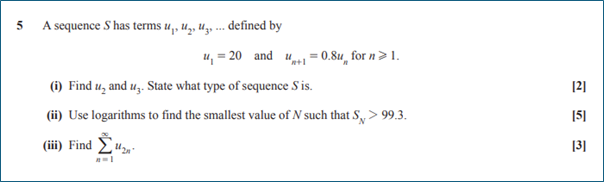
Summer 2018 4722 Core 2 Q5
Here’s a nice question bringing together sections on Sequences and Series with Exponentials and Logarithms. Note that although this was originally part of an AS unit, in the reform it could only feature on the full A Level.
A key assessment requirement is that there should be opportunities for candidates to make links for themselves, without any prompts within the question and in part (iii) there are no prompts directing students towards the sum to infinity formula.
Mathematical reasoning and problem solving
The reformed qualifications have defined Assessment Objectives (AOs) detailing a consistent proportion of marks for AO2 Mathematical Reasoning and AO3 Problem Solving (including mathematical modelling).

Summer 2018 4753 Core 3 Q7
This type of question, with no scaffolded support, was common on the legacy specifications and in the new qualifications is a focus of AO3 Problem Solving. The requirement to set out a clearly-justified solution is a focus of the AO2 Mathematical Reasoning.
Use of technology
The legacy qualifications had a non-calculator paper requirement which is not a feature of the reformed qualifications, where there is an expectation that technology should permeate the study of A Level Mathematics.

Summer 2017 4721 Core 1 Q5
This type of disguised quadratic is typical of the sort of question that can be quickly solved on a calculator. Generally we would use the command phrase ‘In this question you must show detailed reasoning’ for this type of question, which does not prohibit the use of a calculator, but students must demonstrate their understanding of the mathematics needed to solve the problem. Alternatively the term ‘Find’ could be switched to ‘Determine’ which is the command word used to indicate that clearly-justified mathematical working must be seen.
Large data set
One area that does require a more creative approach is in incorporating questions that make use of the Large Data Set (LDS). However, it should be remembered that the requirement that the exam boards provided an LDS was primarily as a teaching resource, and its inclusion into the assessment is so that candidates understand the context of the data source when interpreting results. Replacing the context and data items with information related to the data in the LDS allows for additional question parts to be added that require some deeper evaluation of calculated results.
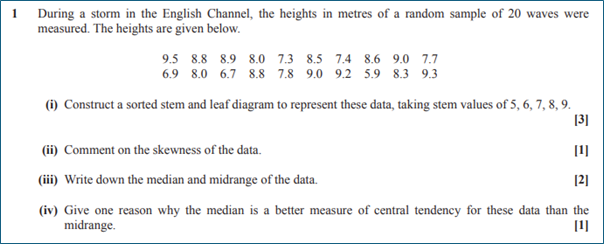
Summer 2018 4766 Statistics 1 Q1
There is less of a focus on drawing statistics charts in the new qualifications and more emphasis on interpretation. It’s unlikely that you will need to draw a full stem and leaf diagram, but perhaps in part (i) students would need to complete a partially-drawn chart. Note that skewness and midrange in parts (ii) and (iii) are not a requirement in Maths A H240, but are ‘on-spec’ for Maths B (MEI) H640. Changing the data from waves heights to something in the LDS allows part (iv) to be more focused on data interpretation and less on memorising generic descriptions of technique limitations.
In summary
Revision for A Level Maths should be focused on practicing a good range of questions from a range of sources and not just restricted to the small set of exam papers set since 2018 for a single reformed qualification. Good questions can be found from the legacy specifications with little or no editing.
Where to find withdrawn qualification material
We have included an archive of ‘Withdrawn qualification materials’ on the Assessment tab of the qualification pages.
Use of questions from across a single year may be an easier option to obtain a balanced blend of questions across the grade boundary spectrum and ensure good specification content coverage.
The questions from these papers can be found on ExamBuilder so that you can collate questions to meet your specific needs.
In the spirit of ‘here’s one I made earlier’ you can find an example set of AS and A Level papers for each specification on Teach Cambridge. The questions have been edited to reflect the accessibility principles applied to the reformed qualification, and the corresponding mark scheme and the notes from the examiners’ reports match these edits.
Stay connected
Speak to your exams officer for access to Teach Cambridge, our secure online space, bringing together our assessment material, teaching resources and professional development courses, to support your teaching of maths. They can also organise access to ExamBuilder.
Sign up for our A Level teacher networks each half term and our professional development webinars.
If you have any questions, you can email us at [email protected], call us on 01223 553998 or message us on social media. Sign up for subject email updates for the latest maths news, updates and resources.
If you are considering teaching any of our qualifications, use our online form to let us know, so that we can help you with more information.
About the author
Steven originally studied engineering before completing a PGCE in secondary mathematics. He has taught secondary maths in England and overseas. Steven joined Cambridge OCR in 2014 and worked on the redevelopment of the FSMQ and the A Level Mathematics suite of qualifications. Away from the office he enjoys cooking and to travel. You can follow Steven on BlueSky or Linkedin.