2D drawing in GCSE Science exams: achieve valuable marks with fewer words
15 September 2026
Amy Brewer, Science Subject Advisor

As GCSE 2026 results are released, science teachers will be reflecting on how they can help all their students to make the biggest gains in the next series, especially those in foundation tier.
In this blog, I explore why drawing skills matter, where students could be losing marks and practical ways to build these skills into everyday teaching.
As a subject advisor, I’m privileged to review examiner reports every year across all 16 papers that contain chemistry questions for Gateway (A) and 21st Century (B) qualifications. Over the last four years, Cambridge OCR has continued to improve the accessibility of the assessments, providing students with a range of different questions to demonstrate their knowledge and understanding. One of these ways has been to use appropriate diagrams within questions and remind students to draw diagrams to develop their responses.
Insights from examiners
Examiners continue to point out that students sometimes struggle to either recognise a 2D drawing of practical equipment, give the names of appropriate equipment, or draw and label equipment clearly in their responses.
This may be a result of the decline in access to practical equipment and practical lesson time that teachers have reported – also noted by examiners in the 2025 exams. But it may also be that students aren’t practising this skill enough.
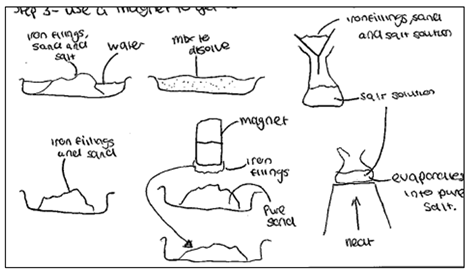
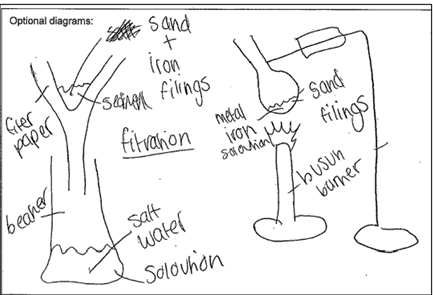
These examples from GCSE Chemistry A (Gateway) J248/01, 2025 show the issue.
This candidate’s drawing was so detailed that they almost achieved all the marks available with their diagram alone:
In contrast, this candidate remembered to add labels to their diagram, which really helped examiners understand it, but it’s clear they hadn’t had many opportunities to practice drawing equipment.
The GCSE Chemistry A specification states that learners need to have been taught, and to have acquired competence in:
- mathematical skill M5b: visualise and represent 2D and 3D forms including two-dimensional representations of 3D objects.
- working scientifically skill WS1.3i: communicate scientific methods used diagrammatically.
Diagrams of practical equipment in questions and responses can meet the requirement of both of these objectives and candidates are missing out on marks when they haven’t been prepared for these skills.
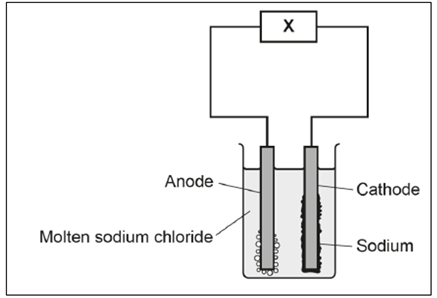
In this example from GCSE Combined Science A (Gateway) in 2025 it was very clear to examiners which students had good practical experience of electrolysis and 2D representations of electrolytic cells, based on their responses about this diagram. Candidates struggled to identify the equipment represented by X, with some calling it a resistor or voltmeter.
Useful resources for drawing skills
Cambridge OCR published materials
Last year, we launched our Purposeful Practical materials. These resources broaden the range of practical opportunities available for schools and particularly support early career and non-specialist teachers.
The included integrated instruction sheets are a great way to introduce students to 2D drawings of the common equipment in classrooms, but they depend on hands-on use and recognition of the 3D object they intend to represent. The instructions also, unfortunately, remove an opportunity for students to practice drawing these themselves.
Other supporting resources
The free equipment flash cards from STEM Learning and the ASE use a photo of the item next to the name and the 2D drawing. You could also print these out and use them on trays or cupboards of equipment – great for accessibility.
CLEAPSS has a similar set of materials (E229) with 3D drawings rather than photos. The disadvantage here is that they are in isolation – they don’t show how to draw an entire set up of equipment for a practical.
Chemix.org is a free app that allows you to build and represent almost any classroom practical. Schools get a discount on an upgrade package, but even without a subscription, most items are available to use; you might miss the boiling tube and spirit burner, but otherwise lots to play with and everything is customisable. The image below (Diagram 1) took minutes to prepare and the images are free to use in the classroom with students, without attribution.
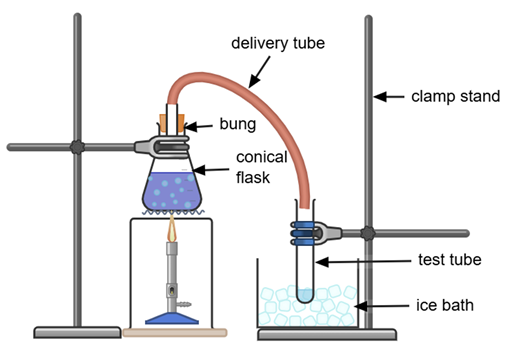
Diagram 1: Shows all of the equipment for a simple distillation (created with Chemix)
Teaching drawing skills explicitly
Ideally, drawing skills are developed from year 7, with a focus on straight lines, basic shapes and good proportions. Teachers should discourage the use of shading, colouring or 3D effects. Examiners are not looking for the use of rulers for diagrams, but it may be helpful to encourage this at the beginning to get scientific representations rather than artistic drawings.
Ideas to incorporate drawing into practical lessons
- Plan and predict. Students could draw the equipment they think they need from a description of the practical or a discussion of the prediction. They could then compare this with what they actually used or with our integrated instruction sheets.
- Find the equipment. Provide students with the integrated instruction sheets first and see if they can find the right equipment and name it properly.
- Investigate a tray of equipment. Provide students with trays of equipment and ask them what they think they are going to do with it, what measurements they might make and in what order might they use the equipment.
- Drawing as homework. Set a follow-up assignment to include drawing a fully-labelled diagram of equipment used in the lesson. Go on to challenge them to draw equipment that could be used to follow a different variable.
- Peer assessment. Students check each other’s diagrams for accuracy and clarity.
Ways to revise drawing and naming skills regularly
- Retrieval practice: incorporate drawing and naming into your lesson structure or play diagram bingo.
- Draw from memory: show the real apparatus or a photo and get students to draw and label.
- Spot the mistake: provide deliberately poor scientific diagrams and have students improve them (see Diagram 2)
- Practical set-up challenge: before demonstrations, ask students to draw the equipment on white boards. Offer bonus points for clear labelling and spelling.
- Vocabulary forfeit: any student who uses the wrong name for equipment could be challenged in a playful way and pick up a forfeit like collecting exercise books
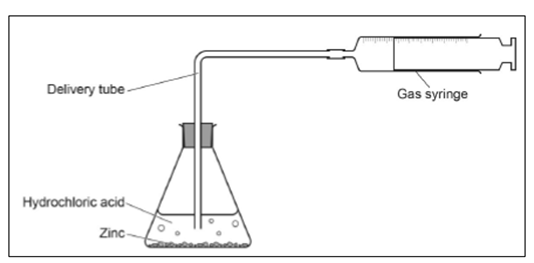
Diagram 2: students should not only spot the mistake, but also explain the consequence of using this apparatus on the results (J248/02, 2025)
Using ExamBuilder to assess progress
Our test building platform, ExamBuilder, includes a wide range of questions from across our science specifications. Searching for simple key words like equipment or apparatus produces some 60 questions testing relevant skills for Chemistry A (Gateway), alone. Usefully, the range of questions includes MCQs (multiple choice questions), LOR (level of response), short answer and drawing and labelling questions, giving students a full range of approaches to test their knowledge.
If you included Chemistry B and the combined science papers, you could get hundreds of different examples. If you would like help with this process, or a copy of the Gateway selection I made, just get in touch.
I’d also encourage you to develop and assess maths and practical skills as often as you can. Our mathematical skills handbook has been updated recently with even better worked examples, teacher tips and student support.
Final takeaways and tips from the examiners
- Include the important apparatus: Diagram 1 is far more complex than is necessary for our questions, and students should be shown what absolutely needs to be included
- …and then label it clearly
- Use a sharp pencil for drawings, and avoid sketching, shading and colouring
- Make apparatus recognisable: a test tube should look like a test tube. Clarity matters
- Show how apparatus connects. For example, if a gas is being collected, the delivery tube should be drawn appropriately and not like in Diagram 2.
Stay connected
If you have any questions, you can email us at science@ocr.org.uk or call us on 01223 553998. You can also sign up to subject emails for the latest news, updates and resources.
If you are considering teaching any of our qualifications, use our online form to let us know, so that we can help you with more information.
About the author
Amy joined Cambridge OCR in May 2022 and is a subject advisor for GCSE Sciences and Applied Science. Before that, Amy taught Chemistry to 11–18-year-olds for 16 years and was responsible for planning her school’s science schemes of learning. In addition to her teaching responsibilities, Amy mentored trainee teachers, was responsible for the progress of KS5 science students. She is committed to improving diversity and inclusion in the sciences.
Related blogs