A Level Maths: elevating mechanics success with pulleys
14 April 2026
Steven Walker, Maths Subject Advisor

Pulley questions in A Level Maths can be challenging for students. These questions require clear visualisation, careful algebra, accurate interpretation of forces and motion, and a solid understanding of modelling assumptions.
This article explores some of the common pitfalls and suggests teaching ideas – developed from teacher reflections and examiner reports – to help students build confidence and accuracy when tackling pulley problems.
Drawing rigorous force diagrams
Successful pulley problem solving begins with accurate force diagrams, but students often skip this stage or draw diagrams they do not then use.
Examiners often note that students confuse the direction of tension, forget to indicate the expected direction of motion, label forces with unclear variable definitions, or miss out individual forces. It is good practice to draw separate force diagrams on either side of the pulley, ensuring that each different force has a unique defined variable name.
Q13 Maths B (MEI) H640/01 2023
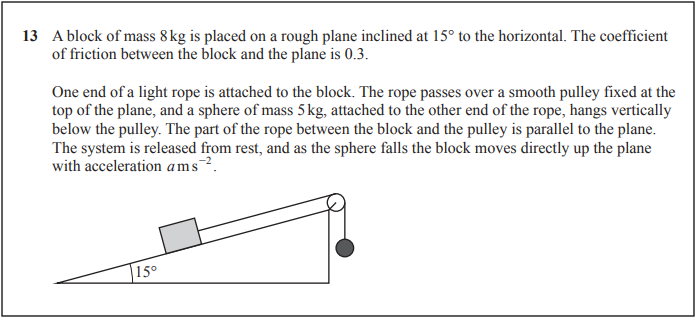
In part (a) this question did ask for a diagram. Common issues were using W for the weight of the block (8kg) and for the sphere (5kg) or using T1 and T2 for the tensions of the rope on either side of the pulley without making clear that T1 = T2 since the pulley is smooth. Using distinct arrows for the direction of motion helps inform the direction of the friction force.
Teaching idea: “Draw what I say.” In pairs, one student describes the forces while the other draws the diagram from the description alone. Comparing the diagram with the original setup helps highlight missing labels, incorrect directions, and imprecise terminology.
Algebraic manipulation and trigonometry confidence
Many errors in pulley questions arise not from misunderstanding the physics but from algebraic and trigonometric slips. Examiners regularly highlight the following: sign errors with force directions, confusion between mass (m) and weight (mg), using incorrect trig ratios (sin/cos confusion) when working with forces on slopes and missing forces (or components of a force) needed for equilibrium.
Q10 Maths A H240/03 2024
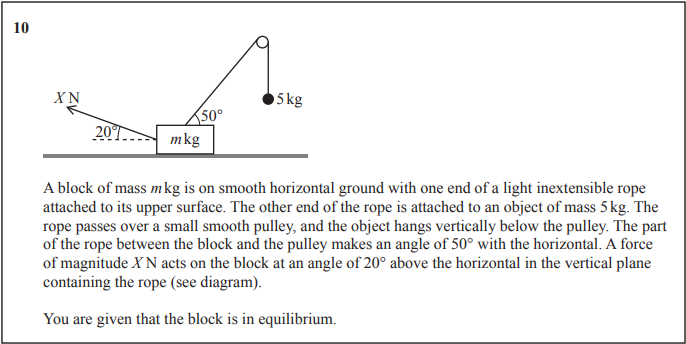
This question required students to determine the value of X, and then m. Those students that drew a force diagram were more likely to successfully complete the question. Common mistakes included using a tension of 5 rather than the correct T = 5g, confusing their sine and cosine functions when looking at the forces acting on the block, or not including all the forces necessary for the block to maintain equilibrium.
Teaching idea: “Fix the working.” Provide deliberately flawed algebra or force resolution steps for students to correct. This encourages the habit of checking direction conventions and the correct use of trigonometry.
Modelling assumptions
Students often remember modelling assumptions but struggle to apply them to the specific situation in a question. Examiners look for comments about how the assumptions influence acceleration, velocity, or forces in the context given.
Q10(d) AS Maths A H230/02 2024
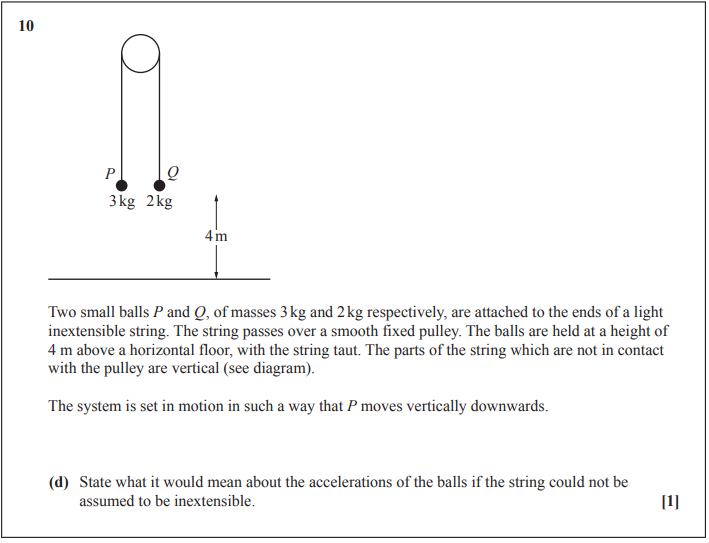
This question involved finding the tension once the system was moving, the speed of P as it hits the floor and the maximum height reached by Q. The final part (d) then looks at the assumptions made in the model about the string specifically related to acceleration. Comments solely about the tension or velocities are not relevant to answering the question which needs to focus on the fact that the magnitudes of acceleration of each ball will not be equal.
Teaching idea: “Contextual rewrite workshop.” Ask students to consider individual assumptions needed to solve exam questions (e.g. a non‑smooth pulley, a heavy rope) and discuss qualitatively how this changes the model. No recalculation is needed: focus on reasoning.
Consider for example in Q13 H640/01 2023, what happens if the mass of the rope is not negligible and that the weight acting on each side of the pulley changes as the proportion of rope on each side changes? In Q10 H240/03 2024, what would happen in the tension along the rope if the pulley were not smooth when increasing the force X?
Summary
Pulley questions combine diagrams, algebra, modelling, and physical reasoning. Strengthening these fundamentals helps students approach mechanics problems more confidently and accurately.
Stay connected
Sign up for our A Level teacher networks each half term and our professional development webinars.
If you have any questions, you can email us at [email protected], call us on 01223 553998 or message us on social media. Sign up for subject emails updates for the latest maths news, updates and resources.
If you are considering teaching any of our qualifications, use our online form to let us know, so that we can help you with more information.
About the author
Steven originally studied engineering before completing a PGCE in secondary mathematics. He has taught secondary maths in England and overseas. Steven joined Cambridge OCR in 2014 and worked on the redevelopment of the FSMQ and the A Level Mathematics suite of qualifications. Away from the office he enjoys cooking and to travel. You can follow Steven on BlueSky or Linkedin.
By the same author