A Level Maths: launching mechanics success with projectiles
14 April 2026
Steven Walker, Maths Subject Advisor

Projectile questions in A Level Maths can be challenging for students. These questions require clear visualisation, accurate interpretation of motion, and a solid understanding of modelling assumptions whilst also requiring careful algebraic manipulation with linear equations, quadratic equations, simultaneous equations and inequalities.
This article explores some common pitfalls and suggests teaching ideas – developed from teacher reflections and examiner reports – to help students build confidence and accuracy when tackling projectile problems.
Representing motion in diagrams
Students often struggle to visualise kinematics because standard distance–time and velocity–time graphs can feel abstract. Projectile graphs are more straightforward with the x and y axis both representing a measure of distance and the curve a quadratic function that represents the flight path. Mapping the projectile flight to a standard quadratic equation can be useful when visualising problems involving a starting point above the ground, or where the particle needs to clear an obstacle. A separate diagram of the particle with annotated arrows for forces and component velocities is often useful.
Q14 Maths B (MEI) H640/01 2024

Sketching the projectile motion makes it more obvious that the 4 ms-1 speed of the man is the horizontal component of the velocity of the ball.
Teaching idea: investigate exam questions using graphing software to develop confidence with the underlying algebra used in the projectile model.
Answering the question set
Projectile questions could ask for time of flight, maximum height, length of time the particle is above a given height, or they could ask for the initial velocity needed to reach a specific height or range. Students need to read the question carefully to ensure they do not set out a perfect mathematical argument that would answer a different question.
Q13 Maths A H240/03 2024
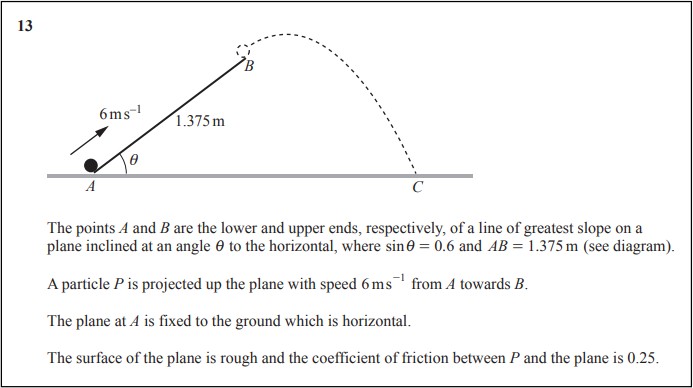
This question links motion on a rough slope with projectiles, but the ‘show that’ aspect of part (a) means that the projectile motion in part (b) can be attempted independent of success on part (a). Examiners noted that there was evidence of candidates not reading the question carefully and only finding the time of flight from B to C, rather than the required time for P to travel from A to C.
Teaching idea: Convert exam questions into goal-free problems so that students recognise a multiple of questions could be set based on a given context stimulus.
Algebraic manipulation and trigonometry confidence
Often errors seen on projectile questions arise not from misunderstanding the physics but from algebraic and trigonometric slips. Examiners regularly highlight incorrect use of trig ratios (sin/cos confusion) when working with the components of velocity or including a non-zero horizontal acceleration.
Teaching idea: Encourage students to replicate the projectile flight using graphing software. This will reinforce the importance of accurate notation, while also providing an opportunity to revise parametric equations.
Q15 Maths B (MEI) H640/01 2023
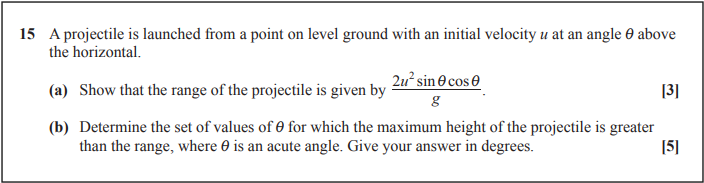
The formula for range was assumed knowledge in some legacy A Level Mathematics specifications, but in the reformed qualification this would need to be derived. Examiners noted that most students made a good attempt on this question, but students dropped marks through ambiguous use of variables or struggled to re-arrange in term of tan θ when working with the inequalities in part (b).
Teaching idea: Challenge students to find the general equation of range of flight when launched h metres above ground.
Modelling assumptions
Students often remember modelling assumptions but struggle to apply them to the specific situation in a question. Examiners look for comments about how a specific assumption will influence a specific aspect of maximum height, flight range or velocity in the given context. Often the modelling part of the question can be answered without necessarily being successful on the calculation part of the question.
Q12 Maths A H240/03 2023
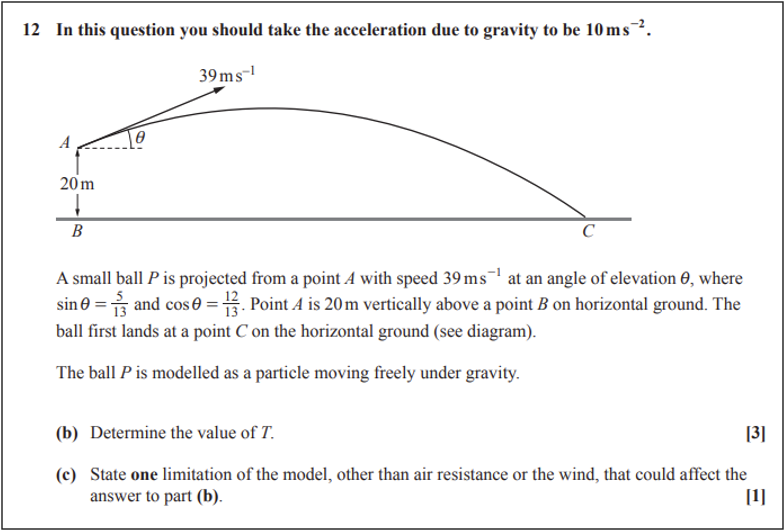
Part (c) was looking for a comment about the mathematical model so focus should be on treating the ball as a particle. Just stating that some of the measurements might not be correct, or that the ball has mass (or weight)/shape without linking this to the actual model may not gain credit.
Teaching idea: MEI has a nice worksheet for undertaking a practical investigation Projectiles – Motion in 2 dimensions. Encourage students to discuss why values calculated would vary if measured in an experiment. Consider what changes would result in increased or decreased maximum height and flight range.
Summary
Projectile questions combine diagrams, algebra, modelling, and physical reasoning. Strengthening these fundamentals helps students approach mechanics problems more confidently and accurately. You may like the following Desmos graphs linked to this article. You may also like the more general Geogebra graph by Waddy.
Stay connected
Sign up for our A Level teacher networks each half term and our professional development webinars.
If you have any questions, you can email us at [email protected], call us on 01223 553998 or message us on social media. Sign up for subject emails updates for the latest maths news, updates and resources.
If you are considering teaching any of our qualifications, use our online form to let us know, so that we can help you with more information.
About the author
Steven originally studied engineering before completing a PGCE in secondary mathematics. He has taught secondary maths in England and overseas. Steven joined Cambridge OCR in 2014 and worked on the redevelopment of the FSMQ and the A Level Mathematics suite of qualifications. Away from the office he enjoys cooking and to travel. You can follow Steven on BlueSky or Linkedin.
By the same author