A Level Maths: the power of sketching quadratics
05 October 2026
Steven Walker, Maths Subject Advisor

Examiner reports consistently highlight that candidates who link graphs and algebra when working with quadratics are more likely to choose efficient methods and avoid common errors.
This article builds on A Level Maths: Using graphs to investigate quadratic functions, using recent exam questions to highlight common pitfalls and practical classroom strategies for teaching quadratic functions and graphs.
Key examiner messages
- Use command words to decide how much reasoning and working must be shown.
- Sketch first. Calculate second.
- Use graphs and algebra together, not separately.
- Check signs, brackets and substitutions carefully to protect accuracy marks.
Command words and the use of calculators
Students should use their calculator efficiently, but they must still be able to demonstrate their understanding of the mathematics involved.
Command words tell students whether an answer only response is enough or whether they must explain their reasoning. In questions such as “Show that”, “Determine” or “In this question you must show detailed reasoning”, working must be presented clearly enough for the method to be followed by the assessor.
Full definitions of the command words that are used in Cambridge OCR A Level Maths are given in each specification, and the following blogs provide exemplification:
We’ve also produced a useful command word poster. For even more exam hints, see our guides for Spec A and Spec B as well as our calculator use poster.
Linking the graph with the algebra
Examiners frequently report that students start manipulating algebra before identifying the information needed. A quick sketch often reveals the quickest route to a solution.
Question 2 Maths A H240/01 2025
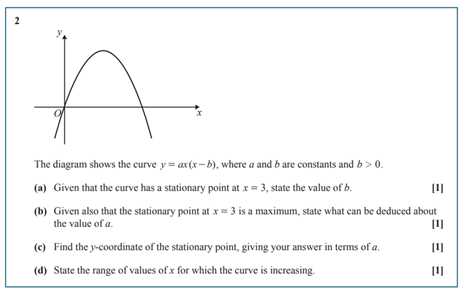
This question assesses symmetry, graph orientation, substitution and gradients for quadratic functions.
Although calculus was valid, many candidates missed simpler approaches available from the graph and structure of the quadratic. Whilst most candidates recognised that a < 0 in part (b), many changed their correct answer of y = -9a to y = 9a, overlooking the fact that, because a is negative, -9a is positive.
Note that there are some different conventions about the inclusion of a point of inflection or turning point when looking at increasing or decreasing functions, so both Cambridge OCR A Level Maths specifications would allow either x < 3 or x ≤ 3 for part (d).
Activity: investigate the properties of a quadratic function using graphing software (such as this Quadratics Desmos graph).
Completing the square
Students will be familiar with solving quadratic equations, plotting quadratic graphs and finding turning points of a quadratic function from Higher tier GCSE. Students often see factorising, completing the square and the quadratic formula as separate techniques but the best solutions apply the approach that reveals the required information most efficiently.
Question 4 AS Maths B (MEI) H630/01 2022
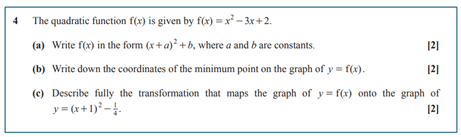
This question helps students move from standard form to completed square form before interpreting the resulting graph transformation.
Examiners noted that most candidates could complete parts (a) and (b), but many struggled with using the concise language required to define the transformations in part (c) unambiguously.
Activity: challenge students to matching quadratic equations in the three-term format with their completed square format (such as this completing the square Desmos graph).
Inequalities
Another related topic is inequalities, where students often struggle with identifying the direction of the inequalities in the final answer. The ability to sketch functions help identify when solution sets should be the region of the graph above or below the x-axis.
Question 1 Maths A H240/02 2025

Examiners reported that candidates who sketched the graph were far less likely to select the wrong interval – a 10-second sketch could prevent a costly sign error in the final answer. As a detailed reasoning question, students must demonstrate their understanding of solving quadratic inequalities. Writing and solving a quadratic equation is a valid method provided that the working makes clear that the roots of the equation are the boundary points and not the final inequality solution.
Activity: Investigate different solutions of quadratic functions depending upon the inequality given (for example, this Inequalities Desmos graph).
Algebraic manipulation
Across all three examples, students who sketched graphs were less likely to make sign errors, choose incorrect intervals or overlook important properties of the quadratic.
Even when the mathematical method is correct, candidates can still lose marks through simple algebraic errors. When solving quadratic problems, a missed bracket or sign error can lead to an incorrect graph, root or inequality solution. For further support, see our Bridging the Gap resource for students starting year 12.
Cambridge OCR support
Students looking to improve their maths could:
- use graphing software to bring together the links across functions, equations and graphs
- practise with past papers
- read examiners’ reports alongside the mark scheme.
Teachers looking to develop these ideas further could:
Stay connected
If you have any questions, you can email us at maths@ocr.org.uk, call us on 01223 553998 or message us on social media. Sign up for subject emails for the latest maths news, updates and resources.
If you are considering teaching any of our qualifications, use our online form to let us know, so that we can help you with more information.
About the author
Steven studied engineering before training as a secondary mathematics teacher. He has taught secondary maths in England and overseas. Steven joined Cambridge OCR in 2014 and worked on the redevelopment of the FSMQ and the A Level Mathematics suite of qualifications. Away from the office he enjoys cooking and to travel. You can follow Steven on BlueSky or Linkedin.
Related blogs