Level 3 FSMQ Add Maths: strengthening kinematics understanding
04 February 2026
Steven Walker, Maths Subject Advisor

Although the FSMQ doesn’t have a dedicated mechanics section, kinematics appears as a key application of calculus and provides a familiar context for mathematical modelling using graphs. In this guide I’ll share feedback from examiners and discuss ideas to help students gain confidence in this topic.
Assumed knowledge across the curriculum
In GCSE (9–1) Mathematics (J560), students will use given kinematics formulas with suvat variables defined in the question, and they will interpret gradients and areas on displacement–time and velocity–time graphs. Students who also study GCSE Physics or Combined Sciences should be familiar with constant‑acceleration equations but may only use descriptive formulae and not the standard suvat symbolic notation.
Teaching tip: Begin the topic with a short review of suvat variables and the distinct meanings of displacement/distance, velocity/speed, and acceleration.
Using a formula sheet
The FSMQ formulae sheet includes both constant acceleration (suvat) and variable acceleration (calculus) equations. Students must decide whether acceleration is constant or variable.
Teaching tip: Use the Check In tests for the calculus section of the specification and the additional formulae sheet Check In tests available on Teach Cambridge to practice identifying and using appropriate formula.
Connecting calculus and graphs
The kinematics content can be taught as an everyday example of calculus, starting with the constant acceleration situation where the velocity time graph is made up of straight lines before progressing to variable acceleration and curved line graphs.
Q6 6993/01 June 2023
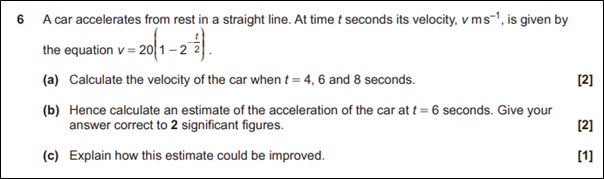
Examiners noted that, in this exam question, many candidates attempted to find the acceleration using suvat in part (b), not recognising the significance of the exponent of t in the initial formula or spotting the fact that their calculated velocities for t = 4, 6 and 8 did not increase by a constant value.
Teaching tip: Use careful language to link rates of change to acceleration and velocity where graphs have straight or curved lines.
Sketching and interpreting graphs
Students often struggle to visualise the information given in kinematics questions. Mapping the information to a velocity time graph can help focus the mind on what needs to be evaluated.
Q2 6993 June 2022
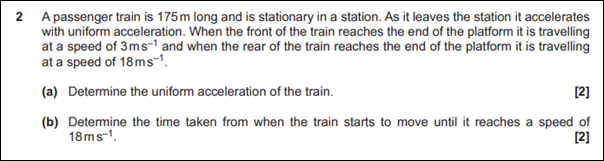
Many candidates struggled to identify the appropriate values for each of the suvat variables. However students that begin with a sketch of the graph, showing a straight line increasing from 0 < v < 18 with the area under the graph between 3 < v < 18 representing a distance of 175 m (see Desmos graph).
Revision ideas
Mechanics questions from AS and A Level papers that just focus on linear motion can make good discussion activities for students preparing for the FSMQ. Try graphing the information provided for Q12 Maths A H240/03 2024 (Desmos example) or Q9 AS Maths B(MEI) H630/01 2024 (Desmos example).
Stay connected
Sign up for our termly FSMQ teacher networks and professional development webinars.
If you have any questions, you can email us at [email protected], call us on 01223 553998.
Sign up for subject emails to receive the latest maths news, updates and resources.
If you are considering teaching any of our qualifications, use our online form to let us know, so that we can help you with more information.
About the author
Steven originally studied engineering before completing a PGCE in secondary mathematics. He has taught secondary maths in England and overseas. Steven joined Cambridge OCR in 2014 and worked on the redevelopment of the FSMQ and the A Level Mathematics suite of qualifications. Away from the office he enjoys cooking and to travel. You can follow Steven on BlueSky or Linkedin.
Related blogs